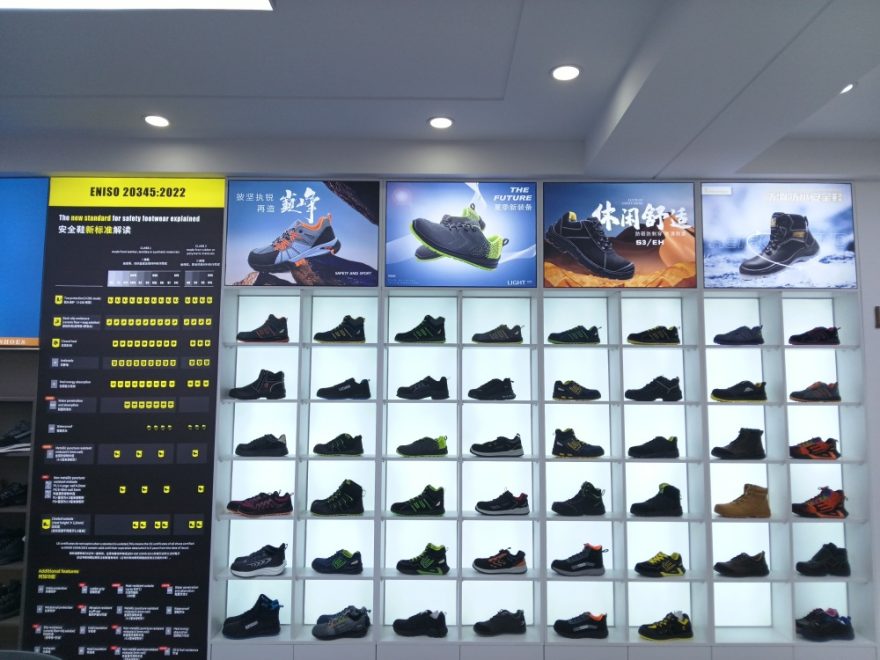
If you have been sourcing safety shoes from China for a while, you have probably seen terms like S1P, S3, SRC, HRO, or ESD everywhere. Many suppliers mention them in quotations, catalogs, and test reports, but surprisingly few buyers fully understand what these codes actually mean in real production and daily use.
That becomes a problem when you are comparing factories, checking quotations, or dealing with claims after shipment.
As someone working closely with safety shoe production, I have noticed that many overseas buyers focus heavily on appearance and price in the beginning, but later discover that certification details directly affect comfort, durability, customs clearance, and even liability risks.
This article explains EN ISO 20345 in a practical way, especially for importers, wholesalers, distributors, and private label buyers who source safety footwear from Asian factories.
What Is EN ISO 20345?
EN ISO 20345 is the main European standard used for certified safety footwear.
In simple words, it defines the minimum protection requirements a pair of safety shoes must meet before being sold as protective footwear in Europe and many other international markets.
The standard covers areas such as:
- Toe protection
- Slip resistance
- Penetration resistance
- Water resistance
- Antistatic performance
- Heat resistance
- Shock absorption
A certified shoe must pass laboratory testing under controlled conditions before the factory can legally claim compliance.
For professional buyers, this is not just about paperwork. It directly affects product positioning, insurance risks, distributor credibility, and long-term customer satisfaction.
Understanding the Most Common Safety Shoe Categories
One of the biggest misunderstandings in the market is assuming all safety shoes offer the same protection.
They do not.
The protection level depends on the certification category.
S1 Safety Shoes
S1 Safety Shoes are usually designed for dry indoor environments.
Typical features include:
- Steel toe or composite toe protection
- Antistatic properties
- Energy absorption in the heel
- Oil-resistant outsole
Factories, warehouses, and logistics centers often use this category because it is lighter and more breathable.
However, S1 shoes are not suitable for wet construction environments because they do not include water resistance.
S1P Safety Shoes
S1P Safety Shoes add penetration-resistant midsoles on top of S1 requirements.
This means the outsole can better resist nails or sharp objects.
S1P is extremely common in industrial sourcing because it balances protection, weight, and cost.
Many Chinese factories produce large volumes of S1P injection safety shoes using PU/PU soles because they remain competitive in price-sensitive markets.
S2 Safety Shoes
S2 Safety Shoes are similar to S1 but include water-resistant uppers.
They are more suitable for environments with moderate moisture exposure.
This category is common in food processing, agriculture, and light outdoor work.
One thing buyers should know: “water resistant” does not mean fully waterproof. Many importers misunderstand this during product development.
S3 Safety Shoes
S3 Safety Shoes are among the most demanded categories in Europe.
They combine:
- Toe protection
- Penetration resistance
- Water resistance
- Cleated outsole for better grip
Most construction distributors prefer S3 because it works across multiple environments.
From a factory perspective, S3 production usually requires stricter material control, especially for leather quality, outsole bonding, and waterproof performance.
This is also why genuine S3 shoes cannot realistically be produced at extremely low prices without compromising materials somewhere.
What Do Additional Markings Mean?
Many buyers see extra codes after S1P or S3 and assume they are marketing terms.
Actually, these markings represent additional tested features.
SRC Slip Resistance
SRC Slip Resistance is one of the most requested requirements today.
The outsole is tested on slippery ceramic and steel surfaces.
Poor slip resistance is one of the most common causes of workplace injuries, especially in logistics and industrial environments.
In reality, outsole design and rubber formulation matter more than many buyers realize. Two shoes may look identical visually but perform very differently during testing.
HRO Heat Resistant Outsole
HRO Heat Resistance indicates the outsole can resist high temperatures for short periods.
This is important in metalworking, welding, and heavy industrial environments.
Rubber outsoles are commonly used for HRO-certified shoes because standard PU outsoles usually cannot meet these temperature requirements.
ESD Protection
ESD Safety Shoes has become increasingly popular in electronics manufacturing and automotive industries.
These shoes help reduce electrostatic discharge that could damage sensitive electronic components.
Many buyers confuse ESD with antistatic footwear, but they are not exactly the same thing. ESD requirements are generally stricter and require controlled resistance ranges.
Why Buyers Should Not Rely Only on Certificates
This is where many sourcing problems begin.
Some buyers focus only on receiving a PDF certificate, without checking whether the actual production matches the tested sample.
In the real world, factories sometimes change:
- Leather grade
- Toe cap supplier
- outsole density
- insole materials
- steel plate thickness
Even small material substitutions can affect compliance performance.
A shoe that passed testing six months ago may not fully match current bulk production if supply chain control is weak.
Experienced buyers usually check:
- Test reports
- Production consistency
- Material traceability
- QC systems
- AQL inspection standards
- Supplier stability
This is especially important for private label orders.
Common Mistakes Safety Shoe Buyers Make
One common mistake is requesting “the cheapest S3 shoe.”
Technically, a factory may still provide an S3 certificate, but cost pressure often forces compromises somewhere else:
- lower-grade split leather
- reduced outsole density
- weaker stitching
- thinner insoles
- lower comfort level
The shoe may pass minimum testing while still generating high complaint rates later.
Another mistake is assuming every factory truly understands European compliance.
Some factories mainly focus on low-cost trading markets and have limited experience with long-term European distributor requirements.
For buyers building their own brand, supplier transparency matters far more than aggressive pricing alone.
How Professional Buyers Evaluate Safety Shoe Factories
Experienced importers usually look beyond catalogs.
They pay attention to details such as:
- Whether the factory controls outsole production internally
- How QC inspections are handled during mass production
- Whether the supplier understands EN ISO testing logic
- How defect claims are managed
- Whether the factory can maintain consistent materials over multiple orders
A factory that openly discusses production limitations is often more reliable than one promising “no problem” for every request.
In safety footwear, realistic communication is usually a good sign.
EN ISO 20345 is not just a technical document for laboratories.
For safety shoe buyers, it is directly connected to product reliability, customer trust, import compliance, and long-term business stability.
Understanding the meaning behind S1P, S3, SRC, ESD, and other classifications helps buyers avoid many expensive sourcing mistakes.
The lowest quotation is rarely the lowest real cost once claims, returns, and reputation damage are included.
Professional sourcing is less about finding the cheapest factory and more about finding the most stable production partner.
FAQ
What is the difference between S1P and S3 safety shoes?
S1P Safety Shoes mainly focuses on dry indoor environments and includes puncture resistance, while S3 Safety Shoes also includes water-resistant uppers and stronger outsole performance for outdoor use.
Are composite toe safety shoes certified under EN ISO 20345?
Yes. Both steel toe and composite toe shoes can comply with EN ISO 20345 as long as they pass the required impact and compression tests.
Does SRC mean the shoes are fully slip-proof?
No footwear can guarantee zero slipping. SRC Slip Resistance simply indicates a higher tested level of slip resistance under laboratory conditions.
Can cheap safety shoes still pass EN ISO 20345 testing?
Sometimes yes, but low-cost production often increases risks related to comfort, durability, consistency, and bulk production quality.
Why do some certified safety shoes still receive complaints?
Certification only confirms the tested sample met the standard. Bulk production quality, material substitutions, and poor QC management can still create problems later.
Many electronics manufacturers require ESD Safety Shoes to help protect sensitive electronic components from electrostatic discharge damage.
- Why Production Delays Happen in Safety Shoes Orders?
- How Safety Shoe Factories Reduce Production Costs ?
- Common Quality Problems in Safety Boots
- Inline Inspection vs Final Inspection: What Really Matters in Safety Shoe Manufacturing?
- Pre-Production Meeting in Safety Shoes Manufacturing — What I’ve Learned Standing Between Sales and the Factory Floor
- AQL Inspection in Safety Footwear Production: What It Really Means on the Factory Floor?
- Safety Shoes Quality Control Checklist for Importers