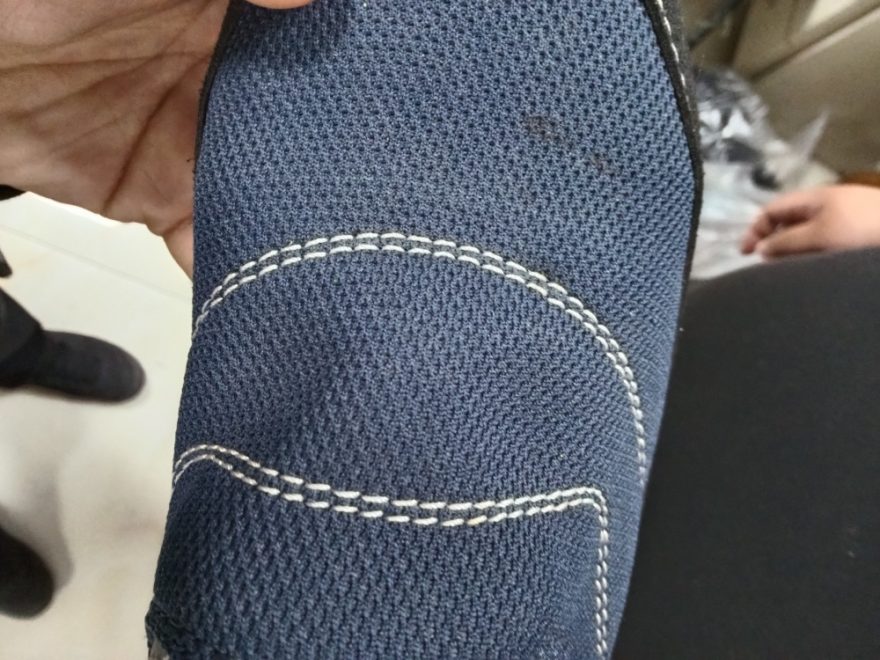
In the safety shoe business, many factory owners still believe small stitching problems are “normal.” A slightly crooked seam, uneven stitch spacing, or loose thread trimming is often treated as a minor cosmetic issue. On low-cost products, people inside factories see these defects every day and gradually become numb to them.
But overseas buyers do not always see things the same way.
Last year, I experienced a case that perfectly showed how a small stitching problem can slowly turn into a very expensive container claim.
The order was for a European customer buying entry-level S1P safety shoes. The target price was aggressive, below 6 USD FOB China. From the beginning, everybody already knew the margin would be extremely tight. The customer wanted a sporty look, lightweight outsole, and fast delivery before the autumn season.
At first, everything looked normal.
The sample approval went smoothly. Materials passed the basic testing. The production line also looked acceptable during the early stage inspection. But after mass production increased, the stitching quality started becoming unstable.
The issue itself was not dramatic.
On some pairs, the stitching around the eyestay area was slightly uneven. A few pairs had loose thread ends. Some shoes showed small differences in stitch distance between the left and right shoe. Inside the factory, most people considered it acceptable for this price level.
That was the first mistake.
The second mistake was even more dangerous: nobody stopped production early enough.
The factory management believed the customer would probably accept it because the shoes were cheap. Workers were already rushing to meet shipment deadlines. Rework would delay the container booking and increase labor costs. So instead of correcting the process properly, they simply instructed QC staff to remove the obviously bad pairs during packing.
But stitching problems are rarely isolated problems.
When stitching quality becomes unstable, it usually means the production line itself is already losing consistency. In this case, the same line later began showing other hidden issues:
slightly uneven tongue positioning, small upper alignment differences, inconsistent foam compression around the collar area, and minor shape deviations after lasting.
Individually, none of these defects looked catastrophic.
Together, they created something much more serious: inconsistency.
That is what many factories underestimate.
Most European buyers are not only checking whether one shoe is “good” or “bad.” They are checking whether the entire shipment looks stable enough for retail shelves. Once buyers feel consistency is lost, confidence disappears very quickly.
The third-party inspection eventually found the stitching issue during random carton sampling.
What made the situation worse was not only the number of defective pairs. It was the visual impact. When inspectors lined several pairs side by side, the stitching inconsistency became very obvious. Some shoes looked clean, while others immediately looked rushed.
For retail customers, visual inconsistency creates a dangerous impression. Consumers may assume the whole product is low quality, even if the shoe still passes functional testing.
The inspection result was not an immediate failure, but the buyer became nervous after seeing the report photos.
Then another problem appeared.
The customer’s warehouse team later found additional stitching defects after arrival because some loose threads became more visible during transportation and unpacking. At that point, the buyer no longer trusted the shipment quality.
The result was painful for the factory.
The customer demanded compensation for sorting costs, warehouse labor, delayed delivery losses, and local reinspection expenses. Part of the container payment was frozen during negotiation. Future repeat orders were also reduced significantly.
Ironically, the actual stitching problem itself was relatively small.
But the chain reaction became expensive because the factory ignored the early warning signs.
This is something many low-cost safety shoe factories still struggle to understand.
In this industry, buyers usually tolerate small defects if they believe the factory is honest, stable, and proactive. But once buyers feel the factory is trying to “push goods out” without proper control, even small problems become trust problems.
And trust problems are always expensive.
Today, whenever I see unstable stitching during production, I pay more attention to the production system behind it rather than the thread itself.
Because stitching defects are often not just stitching defects.
They are usually a signal that production rhythm, worker stability, machine maintenance, or QC discipline is already starting to break down.
That is why experienced buyers often inspect stitching very carefully, especially on large-volume orders.
A small sewing issue may only cost a few cents to fix early.
But once it reaches the customer’s warehouse, it can easily become a full container claim.
FAQ
Why do overseas buyers care so much about stitching quality in safety shoes?
Because stitching directly affects both product appearance and buyer confidence. Even if the shoe still functions normally, inconsistent stitching makes retail products look unstable and low quality.
Are stitching defects considered major defects during inspection?
It depends on severity. Minor loose threads may be classified as minor defects, but uneven stitching affecting appearance consistency can become major defects during AQL inspection.
Why do stitching problems often increase during mass production?
When production speed increases, worker fatigue, machine instability, and rushed QC processes usually reduce consistency. This is very common before shipment deadlines.
Can low-priced safety shoes completely avoid stitching issues?
Not completely. Budget products always face cost pressure. The real difference is whether the factory controls defects early or ignores them until shipment.
What is the biggest risk after buyers discover stitching problems?
The biggest risk is loss of trust. Once buyers believe factory quality control is unstable, they may reduce repeat orders, delay payments, or request compensation.
- The Real Reason Cheap Safety Shoes Fail After 3 Months
- EN ISO 20345 Explained for Safety Shoes Buyers
- Why Production Delays Happen in Safety Shoes Orders?
- How Safety Shoe Factories Reduce Production Costs ?
- Common Quality Problems in Safety Boots
- Inline Inspection vs Final Inspection: What Really Matters in Safety Shoe Manufacturing?
- Pre-Production Meeting in Safety Shoes Manufacturing — What I’ve Learned Standing Between Sales and the Factory Floor
- AQL Inspection in Safety Footwear Production: What It Really Means on the Factory Floor?
- Safety Shoes Quality Control Checklist for Importers