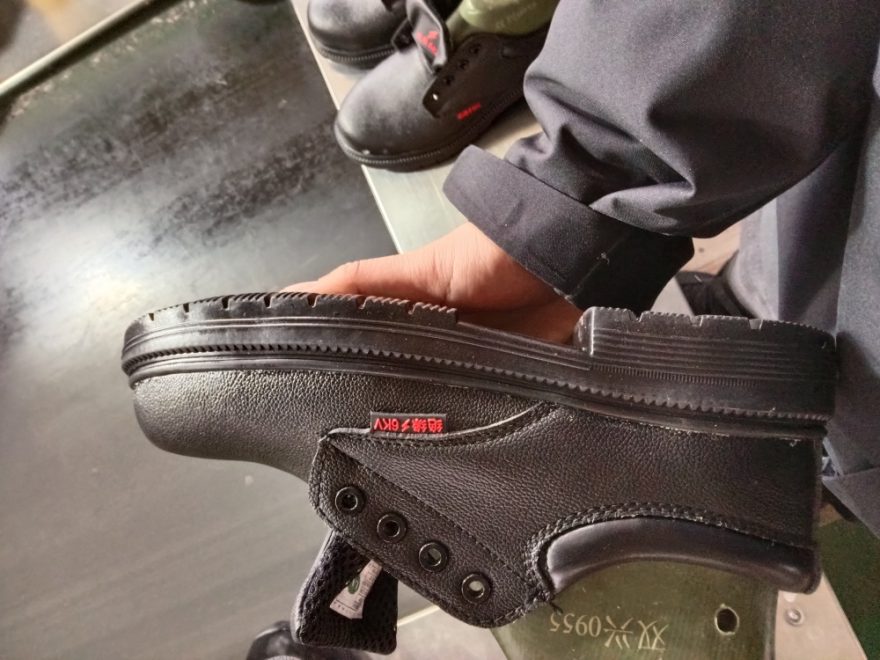
When people talk about quality problems in safety boots, they usually imagine obvious defects—broken soles, damaged uppers, things that can be spotted immediately.
But from my experience working inside a factory, that’s not how it usually happens.
Most problems don’t show up during inspection. They show up later—after shipping, in warehouses, or worse, in your customer’s hands. And by then, it’s already too late.
What makes it more frustrating is that these issues are rarely caused by “lack of capability.” The factory knows how to make the product. The real issue is how consistently that capability is executed across thousands of pairs.
Where Problems Actually Start
If you walk into a production line, everything looks busy and efficient. Workers are focused, supervisors are pushing output, and deadlines are always close.
In that environment, quality becomes something that is assumed—not actively controlled.
A small variation in material, a rushed process step, or a skipped check doesn’t stop production. It just quietly passes to the next stage. By the time the shoes are finished, those small deviations have already turned into real risks.
And this is why final inspection often feels like a gamble.
The Illusion of “Good Material”
One of the most common misunderstandings is around materials.
A batch of leather or microfiber might look perfectly fine when it arrives. Smooth surface, correct color, no obvious defects. But that doesn’t mean it will perform well.
I’ve seen cases where everything passed initial checks, but after a few weeks, the upper started cracking or fading. The issue wasn’t visible at the beginning—it was hidden in inconsistency between batches.
In many factories, material control depends heavily on supplier stability. If that chain is not tightly managed, the risk is already built into the product before production even begins.
Stitching: The Detail That Decides Perception
If you ask a factory what matters most, they’ll talk about safety standards, toe caps, and testing.
But if you ask a European buyer, the answer is often much simpler: “Does it look well made?”
Stitching plays a huge role here.
Even when the product is technically compliant, uneven lines or loose threads immediately lower perceived quality. It gives the impression that the entire product is unreliable.
Inside the factory, stitching problems usually come from speed. When output pressure increases, precision drops. And unlike major defects, these details rarely stop production.
They just accumulate.
When the Sole Comes Off
There’s a moment every exporter wants to avoid: when a customer sends a photo of a separated sole.
What makes this problem dangerous is that it often doesn’t show up during inspection. Everything looks fine when the shoes leave the factory.
The failure happens later.
Bonding depends on multiple variables—adhesive quality, surface treatment, temperature, pressure, timing. If any one of these is slightly off, the result might still pass initial checks but fail in real use.
And once it fails, there is no discussion about “minor defects.” It becomes a full claim.
The Parts You Don’t See
Safety boots are not just about what’s visible.
Toe caps, midsoles, internal structure—these are the components that actually define safety performance. But they are also the hardest to control consistently.
Misalignment, incorrect placement, or even the wrong specification can happen without being noticed during normal inspection.
This is where the gap between “factory standard” and “market expectation” becomes obvious. A factory might consider the product acceptable, but for the buyer, the risk is unacceptable.
Why Sizes Go Wrong
Sizing issues are one of the most common sources of complaints, and also one of the hardest to fix once production starts.
From the outside, it looks simple: follow the size chart.
In reality, it depends on the last, pattern grading, and how strictly those are controlled during production. Small deviations don’t look serious on a single pair, but across a shipment, they create inconsistency.
Customers don’t complain about one pair. They complain when the same size feels different every time.
The Problem Nobody Talks About: Moisture
One issue that many buyers only encounter after their first bad experience is mold.
The shoes leave the factory looking perfect. But after weeks in transit, especially in humid conditions, problems start to appear.
What’s important to understand is that this doesn’t start in the container. It starts in the factory.
If materials are not fully dry, if storage conditions are not controlled, or if packaging is rushed, moisture gets trapped inside. Shipping just makes it worse.
And once mold appears, the product is no longer sellable—no matter how good it was originally.
Small Mistakes That Stop Shipments
Sometimes the biggest problems are not about the product itself.
A wrong label, an incorrect barcode, a missing mark—these things don’t affect how the shoes perform. But they can stop a shipment from being accepted.
From a factory perspective, these are “simple mistakes.” From a buyer’s perspective, they can disrupt the entire supply chain.
And they often happen at the very last stage, when everyone is focused on shipping as fast as possible.
What This All Comes Down To
After spending time inside production, one thing becomes very clear.
Quality is not about whether a factory can make a good product.
It’s about whether they can make the same product, the same way, every time.
Most factories are capable. But without consistent control over materials, processes, and checks, the result becomes unpredictable.
And unpredictability is what buyers are really paying to avoid.
FAQ
Q1: What is the most common quality issue in safety boots?
From experience, sole bonding problems are among the most serious because they often appear after delivery, not during inspection.
Q2: Why do safety boots sometimes develop mold?
Usually because moisture is already present before shipping—either from materials, environment, or packing conditions.
Q3: Can a factory with good samples still have quality issues?
Yes. Samples are controlled carefully, but bulk production depends on consistency, which is much harder to maintain.
Q4: Are visual defects the biggest concern?
Not always. Structural issues like bonding or internal components are often more critical, even if they are not visible.
Q5: How can buyers reduce risk when sourcing safety boots?
By focusing less on final inspection and more on how the factory controls production at each stage.
- Pre-Production Meeting in Safety Shoes Manufacturing — What I’ve Learned Standing Between Sales and the Factory Floor
- AQL Inspection in Safety Footwear Production: What It Really Means on the Factory Floor?
- Safety Shoes Quality Control Checklist for Importers
- How to Control Quality Before Shipment?
- Payment Risks in Safety Shoes Import Business — What Most Buyers Only Learn After Losing Money?
- Factory Direct vs Trading Company: What Importers Should Know?