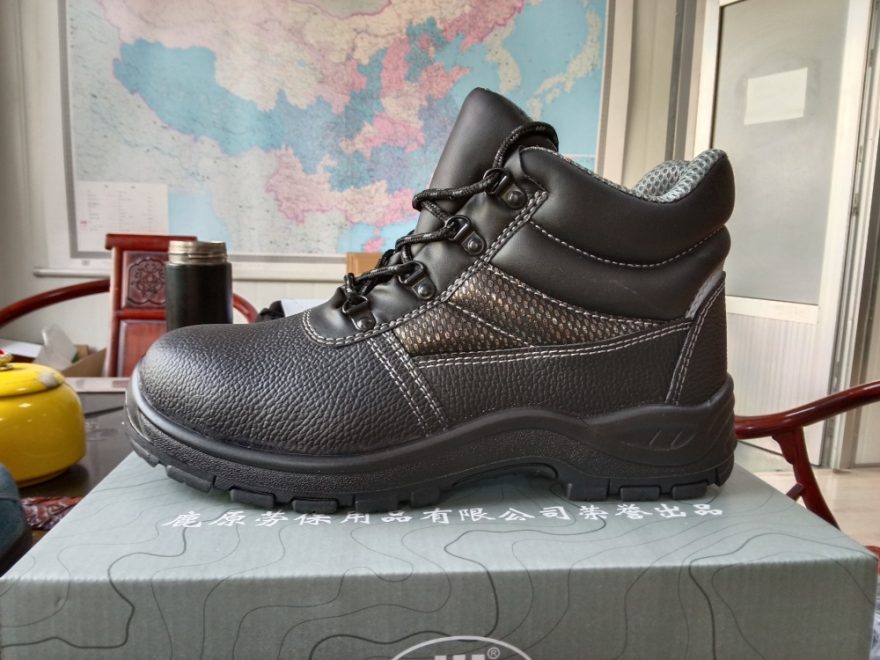
When people buy a pair of safety boots, they usually only see the finished product — strong leather, a steel toe, maybe a slip-resistant sole. But behind that pair of boots is a long process that most buyers never get to see.
Working in the safety footwear industry for years, I’ve visited many factories in China. Some are well organized, some are chaotic, but the basic production logic is similar everywhere. A pair of safety boots always begins long before the production line starts moving.
The first step is always material preparation. Good safety shoes depend heavily on the quality of raw materials. Full-grain leather is still the most common upper material for industrial boots because it balances durability and breathability. For some lighter models, microfiber or split leather may be used to control cost. At the same time, the factory prepares the steel toe caps, puncture-resistant midsoles, lining fabrics, insoles, and outsole materials such as PU, rubber, or TPU.
In many Chinese factories, these materials do not come from a single supplier. Leather might come from one region, steel toe caps from another supplier, and PU chemicals from specialized chemical companies. Managing these materials properly is already half of the production challenge.
Once materials arrive, the cutting process begins. Large leather sheets are placed under hydraulic cutting machines. Workers use metal molds to cut precise shapes for different parts of the upper. This step looks simple, but experienced workers know how to avoid weak areas in the leather. If cutting is careless, the boots may crack after months of use.
After cutting comes stitching, which is where the upper of the safety boot takes shape. Workers sew together the vamp, tongue, quarters, and padding. At this stage the boots finally begin to look like footwear instead of scattered pieces of material. In better factories, quality inspectors check stitching density and alignment because poor stitching can cause early failure in the field.
Then comes one of the most important steps: lasting. The stitched upper is pulled tightly over a shoe last, which gives the boot its final shape. The steel toe cap is inserted during this stage. This process requires skill because the leather must stretch smoothly around the toe cap without wrinkles.
Next is sole attachment. Many Chinese safety boots use direct injection PU soles. In this process, the lasted upper is placed into a mold and liquid polyurethane is injected around it. When the PU reacts and solidifies, the sole becomes permanently bonded to the upper. Compared with glued soles, direct injection usually provides stronger bonding and better waterproof performance.
For rubber safety boots, the process can be slightly different. Rubber soles are often molded separately and then attached through vulcanization or adhesive bonding.
After sole assembly, the boots move to finishing. Workers trim excess material, clean glue marks, and insert insoles and laces. Each pair is then inspected for defects — checking the toe cap position, sole bonding, and overall appearance.
But production is not the final step. For export orders, safety boots usually undergo additional testing. Factories or third-party laboratories test impact resistance of the steel toe cap, compression resistance, slip resistance of the outsole, and sometimes puncture resistance of the midsole. These tests ensure the boots meet standards required by overseas markets.
Finally, the finished boots are packed into boxes and prepared for shipment. From raw leather to the final carton, the entire process usually takes several weeks depending on order size.
Many buyers assume safety boots are simple products. In reality, they combine materials science, mechanical protection, and traditional shoemaking skills. Small details in production often determine whether the boots will last six months or several years in real working conditions.
That’s something I’ve learned after spending years inside Chinese safety footwear factories. The difference between an average pair of boots and a reliable pair is rarely visible at first glance — but it is always hidden somewhere in the production process.
- If you’ve ever purchased safety shoes from China, you’ve probably heard of Gaomi.
- Why Misunderstanding Material Specifications Causes Safety Shoe Test Failures?
- I’m Alexey. I work at a Chinese factory that makes safety shoes.
- Why Material Batch Differences Cause Hidden Quality Problems in Safety Shoes?