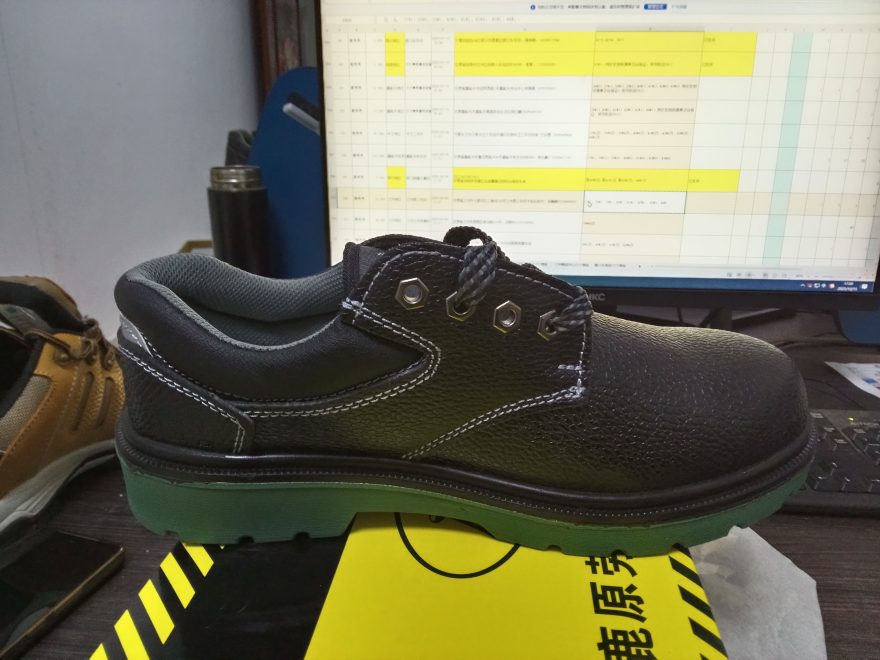
If you’ve been sourcing safety shoes from China for a while, you’ve probably had this moment.
The sample looks solid. Clean stitching, good shape, everything feels right. You approve it, place the order, wait for production… and when the bulk arrives, something feels slightly different.
Not completely wrong. Just not exactly the same.
From a buyer’s side, this is frustrating. From a factory side, it’s something we deal with all the time.
And to be honest, it doesn’t always mean the factory is trying to cut corners.
A sample is not made under real production conditions
When we make samples in the factory, the environment is very different from bulk production.
There’s no pressure from deadlines. No need to coordinate with multiple lines. No need to worry about output speed.
Usually, one or two experienced workers handle the sample. If something looks off, they redo it. If the material doesn’t feel right, they switch it. Even small details get extra attention because the goal is simple: make the product look good enough to win the order.
At this stage, cost is not the priority. Presentation is.
That’s why samples often look “perfect”.
Bulk production is where reality shows up
Once the order is confirmed, everything changes.
Now it’s not about one pair—it’s hundreds or thousands. Materials come in batches. Workers rotate. Machines run continuously.
Even if the factory follows the same process, small differences start appearing naturally.
One worker applies glue slightly heavier, another one a bit lighter. One batch of leather feels slightly softer than the previous one. The temperature in the workshop changes bonding performance without anyone noticing immediately.
Individually, these differences are small. But across a full production run, they become visible.
And unlike sample making, you don’t stop the whole line just to fix one pair.
The supply chain is never as stable as it looks
This is something many buyers don’t see.
During sampling, factories sometimes use what’s available and best at that moment. Materials might come from stock, or even from a supplier that isn’t the final one for bulk.
But when production starts, materials are ordered in volume. And that’s where variation enters.
Even if it’s the same supplier, different batches can behave differently. Color tone shifts slightly. Density changes a bit. Some materials are more stable, some are not.
In safety shoes, especially, components like outsoles, toe caps, and lining materials can come from different sources. Keeping everything 100% identical across batches is extremely difficult.
Quality control doesn’t mean perfection
Factories do have inspection systems. In many export orders, they follow AQL standards for final inspection.
But AQL is not about checking every single pair. It’s about checking a portion and deciding whether the whole batch is acceptable.
So when a shipment passes inspection, it means the quality level is within an agreed range. It does not mean every pair matches the sample exactly.
This is something experienced buyers understand quickly. New buyers usually learn it the hard way.
Sometimes the problem starts at the sample itself
This part is uncomfortable, but real.
Some factories put too much effort into samples—more than what can realistically be maintained in production.
They might use slightly better materials, assign their best workers, or spend extra time refining details that won’t be practical later on.
The sample becomes a “best version”, not a “repeatable version”.
When bulk production begins, the gap appears.
The difference is not the problem. The expectation is.
In most cases, disputes don’t happen because the product is unusable.
They happen because expectations were not aligned.
Buyers expect duplication. Factories deliver consistency within tolerance.
That gap in understanding is where problems start.
What actually works in real sourcing
From what I’ve seen, buyers who run into fewer issues don’t rely on the sample alone.
They treat the sample as a reference, not a guarantee.
They ask more questions before production starts. They care about where the materials come from, whether the process is stable, and how the factory controls variation.
Some of them even request a pre-production sample made under real conditions, not just a showroom sample.
It doesn’t eliminate all problems, but it reduces surprises.
Final thought
If you’ve ever felt that “the bulk is not exactly like the sample”, you’re not wrong.
But in manufacturing—especially in products like safety shoes—what matters is not whether they are identical, but whether they are consistent and acceptable.
That’s a very different standard.
And once you understand that, sourcing becomes much more predictable.
FAQ
Why does my bulk order look slightly different from the sample?
Because samples are made with more control and less pressure, while bulk production involves multiple variables like workers, materials, and production speed.
Is it possible to make bulk exactly the same as the sample?
In reality, no. Factories aim for consistency, not perfect duplication.
What is the biggest risk factor in bulk production quality?
Material batch variation and production process consistency are the main factors.
Should I worry if there are small differences?
Only if they affect function, safety, or overall appearance beyond acceptable limits.
How can I reduce the gap between sample and bulk?
Focus on production process, not just the sample. Confirm materials, request pre-production samples, and stay involved during early production.
- Top 10 Risks When Importing Safety Shoes from China
- How Chinese Factories Handle OEM Safety Shoes Orders?
- Key Materials Used in Modern Safety Footwear
- Typical Production Timeline for Safety Shoes Orders
- From Raw Materials to Finished Safety Boots: What Really Happens Inside a Chinese Factory?
- Safety Shoes Industrial Clusters in China Explained — From My Perspective
- Why Small Problems in Safety Shoe Factories Often Turn Into Big Ones?